
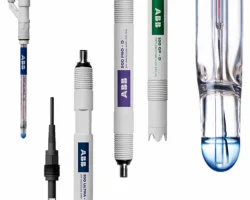
ABB 100 GP pH/ORP Sensor – 3/4″ NPT
The ABB 100 GP pH/ORP analog sensor is a rugged, general-process pH ORP electrode for continuous water and wastewater duties—built for fast response, stable readings, and low-maintenance operation in plants like drinking water, municipal wastewater, and cooling water systems.
ABB’s 100 GP is designed for everyday process measurement where you need dependable pH or ORP tracking without constant attention. It combines high-performance glass options with a close-coupled temperature element (for better accuracy during temperature swings) and a robust PVDF 3/4" NPT body suited to industrial service.
For longer lifetime in tougher streams, the sensor uses an extended double-junction Ag/AgCl reference with an ion trap and a large-surface PTFE junction to resist fouling and delay poisoning effects.
Specifications
- pH range: 0 to 14 pH
- ORP (Redox) range: –2000 to 2000 mV
- Process temperature: –5 to 60 °C
- Pressure: 0 to 6 bar @ 25 °C
- Process connection: 3/4″ NPT
- Body material: PVDF (3/4″ NPT body)
- pH glass options: High performance (S) glass (bullet/flat), Low temperature (LT) glass
- ORP electrode: Platinum
- Reference system: Extended double-junction Ag/AgCl + ion trap (gel matrix)
- Reference junction / seals: Porous PTFE + Viton O-rings
- Connection types listed: BNC + Molex, Tagged, VarioPin
Benefits
- Fast, accurate response with close-coupled temperature measurement for changing process conditions.
- Longer service life in real plants thanks to double-junction reference + ion trap and a fouling-resistant PTFE junction.
- Strong mechanical/chemical durability using a PVDF body and universal 3/4″ NPT mounting.
- Easier commissioning: supplied with a calibration certificate.
- Flexible installation with detached or integral cable options and multiple connection styles.
Why choose
- You need a general process pH sensor that stays stable in typical plant streams (water, wastewater, cooling).
- You want better resistance to poisoning/fouling than basic electrodes—supported by ABB’s double-junction + ion-trap approach and large PTFE junction.
- You prefer a sensor that mounts easily using a universal 3/4″ NPT body and offers common connection styles for analyzers and transmitters.
FAQ
1. What is the ABB 100 GP pH/ORP sensor used for?
Continuous pH or ORP monitoring in water and wastewater processes such as neutralization, effluent control, and general utility water lines.
2. Does ABB 100 GP measure both pH and ORP?
Yes—select the pH version (glass electrode) or the ORP version (platinum electrode) depending on whether you need pH or redox measurement.
3. What is the pH range of ABB 100 GP pH sensor?
It supports full-scale pH measurement from 0 to 14 pH.
4. What is the ORP (redox) range of ABB 100 GP ORP sensor?
It covers –2000 to +2000 mV for ORP measurement.
5. What is the process connection size for ABB 100 GP sensor?
The sensor uses a 3/4″ NPT process connection.
6. What temperature and pressure can ABB 100 GP handle?
It is specified for –5 to 60°C process temperature and up to 6 bar at 25°C.
7. Which cable/connector type should I choose (BNC, VarioPin, Tagged)?
Choose the connector option that matches your analyzer/transmitter input and your existing cabling—this prevents installation rework.
8. Is ABB 100 GP suitable for low-conductivity water?
ABB recommends a minimum conductivity of 50 µS/cm for reliable measurement in typical applications.
9. How often should I calibrate the ABB 100 GP pH sensor?
Calibration frequency depends on process conditions (fouling, chemical exposure, temperature swings). In most plants, routine calibration is done on a schedule (weekly/monthly) or when readings drift.
10. Why does my pH/ORP reading drift with ABB 100 GP?
Common causes are coating/fouling on the sensor tip, aged reference, poor grounding/shielding, air bubbles, or low conductivity—cleaning and recalibration usually restores performance.
11. Can ABB 100 GP be installed in-line or in a flow cell?
Yes—installation depends on your hardware (immersion assembly, flow cell, or insertion fitting). Match the 3/4″ NPT and ensure proper flow/contact with the process.
12. How do I choose between ABB 100 GP “S glass” and “LT glass” options?
Use standard/high-performance glass for normal conditions; choose low-temperature glass when your process runs cold and you need better response at low temperatures.
Reviews
There are no reviews yet.